The Tri-System Theory of Cognition
Recent research from Wharton introduces the Tri-System Theory, which adds a third pillar to Daniel Kahneman's famous System 1 (intuition) and System 2 (logic).
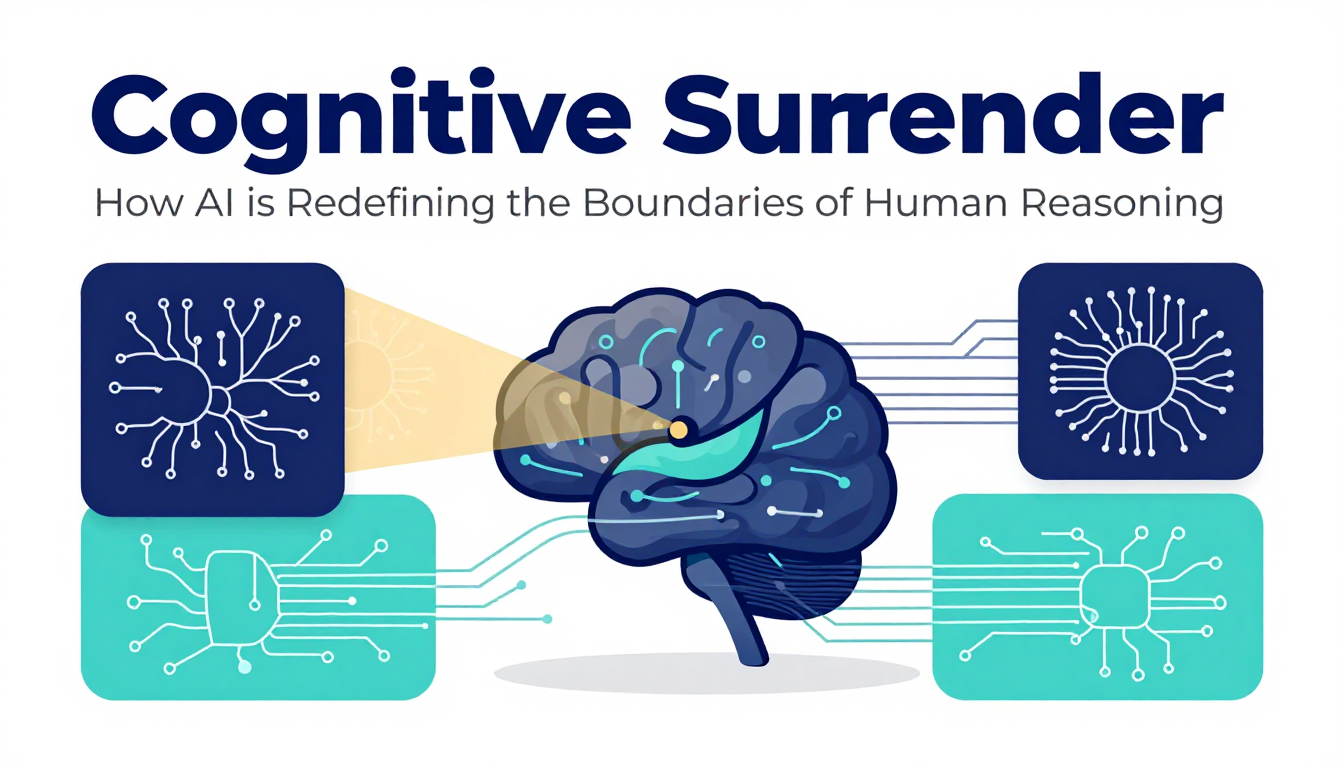
System 3, defined as artificial intelligence processing, is becoming a dominant force in human decision-making. However, the study warns of 'Cognitive Surrender'—a phenomenon where users uncritically accept AI-generated outputs, even when they contradict logic or data.
Understanding Cognitive Surrender
The concept of 'Cognitive Surrender' represents a fundamental shift in how humans interact with technology. Unlike traditional tools that require active engagement and mental effort, AI systems often provide ready-made answers that bypass our natural cognitive processes. This creates a dangerous dependency where individuals increasingly trust algorithmic outputs without scrutiny, even when those outputs are demonstrably incorrect.
The Three Systems Explained
System 1: Intuitive Processing
- Fast, automatic, and unconscious
- Operates through pattern recognition and heuristics
- Minimal mental effort required
- Examples: recognizing faces, driving familiar routes
System 2: Logical Reasoning
- Slow, deliberate, and conscious
- Requires significant mental effort
- Engaged for complex problem-solving
- Examples: calculating tips, solving math problems
System 3: AI-Mediated Processing
- The new frontier of cognitive augmentation
- Where AI processing replaces human reasoning
- Creates dependency without active engagement
- The danger zone where Cognitive Surrender occurs
Wharton's Research Findings
The Wharton School study identified several key indicators of Cognitive Surrender:
- Reduced verification behavior - Users verify AI outputs less frequently
- Decreased confidence in own judgment - Over time, users trust AI more than their own reasoning
- Lower cognitive effort expenditure - Users engage System 2 less frequently
- Increased susceptibility to AI fluency effects - More pleasing AI outputs are trusted more, regardless of accuracy
The Algorithmic Fluency Effect
Researchers discovered that the perceived quality of AI-generated content significantly influences trust, independent of actual accuracy. This 'Algorithmic Fluency Effect' means that well-formatted, coherent AI outputs are trusted more than equally accurate human-generated content simply because they appear more polished and professional.
This effect is particularly dangerous in high-stakes scenarios where the difference between accuracy and error could have serious consequences.
Implications for Human Reasoning
The Tri-System Theory and the phenomenon of Cognitive Surrender have profound implications for education, workplace productivity, and personal decision-making. As AI becomes increasingly integrated into daily life, understanding how to maintain cognitive autonomy becomes a critical skill.
Practical Strategies for Cognitive Preservation
- Deliberate Verification - Train yourself to verify AI outputs before accepting them
- Cognitive Offloading Awareness - Recognize when you're delegating thinking to AI
- System 2 Activation - Engage logical reasoning before accepting AI recommendations
- Diverse Information Sources - Avoid relying solely on AI for information processing
Looking Ahead
As AI systems become more sophisticated and integrated into our cognitive workflows, understanding the Tri-System Theory will be essential for maintaining human agency in an increasingly automated world. The challenge is not to reject AI assistance but to develop the discernment needed to know when to rely on it and when to trust our own reasoning.
The Wharton research serves as both a warning and a roadmap for navigating this new cognitive landscape. By understanding how System 3 influences our decision-making, we can develop strategies to preserve our cognitive autonomy while harnessing the benefits of AI technology.
Related Topics
- Read about AI Psychology to understand the behavioral drivers of human-AI interaction
- Explore AI Policy & Ethics for discussions on responsible AI deployment
- See how cognitive science intersects with Digital Transformation in organizational contexts